


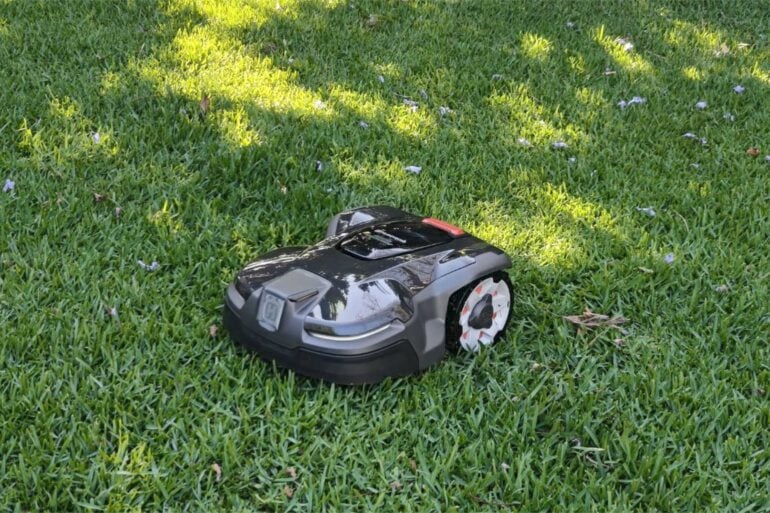
Husqvarna approached me and asked if I would like to trial a robot lawn mower. Let me think, do I want a machine to cut my lawn for me for two months? The answer was, of course, yes! They then asked whether I would like to compare a boundary wire ‘dumb’ robot lawn mower to a GPS-guided model. This surprised me: I just assumed that Husqvarna would send its flagship mower and be done with it.
So, I ended up testing two models: the $5,147 Husqvarna Automower 410XE NERA, which comes with a wireless EPOS (Exact Positioning Operating System) navigation system, and the $3,499 Automower 415X, which uses physical boundary wires to navigate lawns.
Comparing a GPS robot lawn mower versus one that relied on boundary wires was an interesting exercise, one that showed that ‘one size fits all’ does not apply to the world of robot mowers.
Setting up the robot mowers
I then expected two boxes to arrive, and I was on my own. No, the next step was a call from a Husqvarna dealer. He told me he was looking at my property on Google satellite view and thought a GPS model would not work in my backyard because of the trees, but would work in my front yard. My backyard is large, and my front yard is small, so I was disappointed.
Husqvarna will send you a box to set up yourself, but for a fee of around $400, a dealer will advise you on the right model and install it. It also helps that they have the know-how and equipment to do it right the first time.

First to be installed was the boundary wire mower. Here, a wire is run around the boundary of your lawn and energised from the mower’s charging station. For both mowers, you need access to 240 volts to run out to the base station. The GPS base station also needs a separate 240-volt power supply.
Aaron from Western Mowers and Chainsaws had a machine that laid the cable in about 10 minutes with no visible damage. If I had done it myself, it would have taken all day. The mower was then powered up, and off it went.
After setup, Automower Connect is where the magic happens. It’s an app that controls your robot mower; after a week, you can also use the app to see a map of the mowing area. At this point, the app, having figured out how long it takes to mow, can help you set a schedule for how often the robot mows.
Most robot lawn mowers use rotating discs with razor blades that trim the tops off the grass leaves, which then fall as mulch to act as a fertiliser. By default, mowing will occur at least three times a week, so your grass will always look immaculate. Aaron also told me that, because the grass is cut more often, it grows more sideways, giving a thicker grass cover. Note that the razor blades need to be changed every two months to maintain effective cutting.

The front yard actually took longer to install, since a separate GPS reference station needs to be installed, which improves the GPS-guided mower’s location accuracy. It also required driving the mower around the boundary manually to set the mowing area.
The GPS, or, in Husqvarna-speak, EPOS mower, can navigate between different sections of the lawn. However, the narrow path back to the front of my house was not suitable for this navigation, nor could I get the mower to mow the nature strip, as the incline back to the main front grass section on our property was too steep for the model I am trialling.
Once set up, a virtual boundary is easier to move than a wire boundary, and the mower’s path can be defined rather than random, giving your lawn a different look.

Comparing GPS and boundary wire robot mower tech
So how are they performing? My wife, who has no interest in gadgets but tolerates my interest in them, said she loves the robot mowers and will be sad to see them go.
Although the EPOS mower has edge-cutting technology, you will still need to run a whipper snipper along the boundaries of both GPS and boundary-wire lawns. This takes me less than 10 minutes and saves me the hour-long job of mowing every two weeks (less in winter, more in summer).
My wife loves it because the lawn has never looked so good. It always looks nice seven days a week, not just one day after a traditional mow. Being the jacaranda flower season in Sydney, it even does a pretty good job of cutting up the flowers.
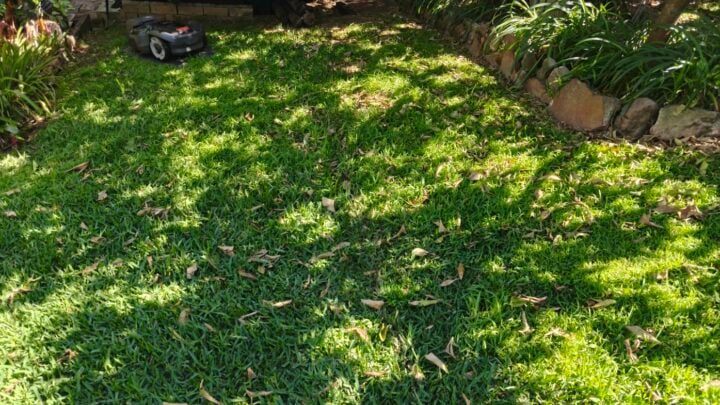
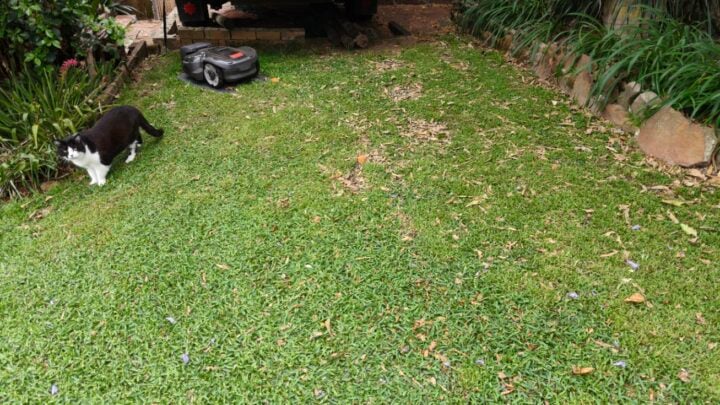
Neither mower likes sticks, so you do need to look out for them and pick them up. The EPOS unit is able to avoid obstacles, but the boundary wire mower runs into the clothes line every time. Both do have safety mechanisms and a big red stop button on the top.
I so want to say the pricier GPS model is my favourite and better, but to be honest, I just want my lawn cut. For my situation, the larger area of grass is being done well by a cheaper model with a boundary wire.
What I have learned is that having a dealer recommend the model and do the installation has meant it all works as intended. I will be sad to see my robot mower go, forcing me to pick up where it left off.
The post GPS vs boundary wire robot lawn mower: Which is better? appeared first on GadgetGuy.
0 (mga) komento:
Mag-post ng isang Komento