



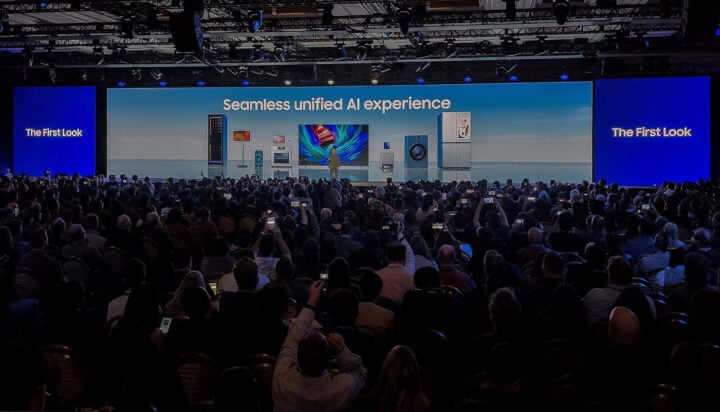
At yesterday’s Samsung First Look press conference at CES 2026 in Las Vegas, CEO TM Roh promised to incorporate AI into every Samsung product to “create a seamless experience”. He also promised the “best AI experiences” and “strong user benefits”, though he did not specify what those user benefits would be.
He said that his goal was “unifying how our devices work together”, with consistent interfaces all around the home. In practice, this means that Samsung’s One UI is expanding to fridges and TVs, with Now Brief and Bixby being introduced across more devices.
Samsung just won’t let Bixby die.
Having now had hands-on with some of the TVs and fridges, it’s easy to see how this could be incorporated into the lives of Samsung users and give them a more seamless experience across devices. People often shout out Apple as having an ecosystem where everything just works together, and this seems to be Samsung’s way of saying, “hold my beer while your fridge scans it and notes the best before date”.
A more customised TV experience
In the carefully controlled demos at the event, the person running the demo was able to ask Samsung’s TV to mute the commentary during a soccer game, only playing the sounds of the stadium and the players.
In fact, there’s a whole AI soccer mode, designed to recognise the ball, players, commentary, atmospheric sounds and grass, and then use AI to enhance each of those details. Once again, in the controlled demos, it looked excellent and made me excited about getting to watch Matildas games on it.
During the conference, SW Yong, Head of Visual Display Business, talked up how Samsung had been the most popular TV manufacturer for the last 20 years. He boasted that all 830+ million TVs Samsung had sold in the last 20 years could wrap around the Earth side by side 24 times. That visual is perhaps less awe-inspiring and more horrifying than Yong was going for, but it certainly paints a picture.
Yong is now looking to the future, and says that the next 20 years will take TVs further than just picture quality. For Samsung, that vision seems to be placing the TV at the centre of the connected home. A screen you watch movies, shows and sports on, but also an art piece, with the OLED range now getting access to the art store for the first time (it uses a pixel shift technique to prevent burn-in).

The OLED TVs look stunning with the art on display, and it really does make the TV more than just a black mirror when it’s off. Beyond that, the aim is for the TV to control the connected smart home by being a Smart Things Hub, as well as using the new AI button on the remote to answer such hard hitting questions as “what is the movie I’m watching about” (the TV then continues playing the movie in a tiny window while it reads you a summary of the film and presents that summary in large text).
Beyond just looking at what the current TVs can do, Samsung is also pushing ahead with new screen technologies. Long term, Micro LED is where things are going, and the business screens on display were stunning (though they’re still impractical for home use at this point). In the medium term, Micro RGB is the future, and at CES, Samsung announced a 130-inch Micro RGB TV to go alongside the 115-inch that is currently available in Australia for more than $40,000.
The massive Micro RGB TV was announced to rapturous applause and mild profanity from the audience in Las Vegas. In person, it looks incredibly vibrant, with the extremely red red particularly standing out, even from a distance. Up close, I was stunned by how thin and beautiful the TV is. Truly, it’s the most vibrant and beautiful home TV I’ve seen so far. Samsung is also planning on announcing a full range of Micro RGB sizes, ranging from 55 inches, which should hopefully be more affordable (relatively speaking). It’ll be interesting to see what prices they land at and what adoption of the technology will be like.
With the Micro RGB range, Samsung is using HDR10+ Advanced and Eclipsa audio. Samsung is the first to implement HDR10+ Advanced. Prime Video will have some HDR10+ Advanced titles available soon, though it’s unclear how many “some” is. While I couldn’t properly hear the Eclipsa audio in a busy demo suite, the HDR10+ Advanced really did convey excellent depth of colour and texture. I can’t wait to properly test it later this year.
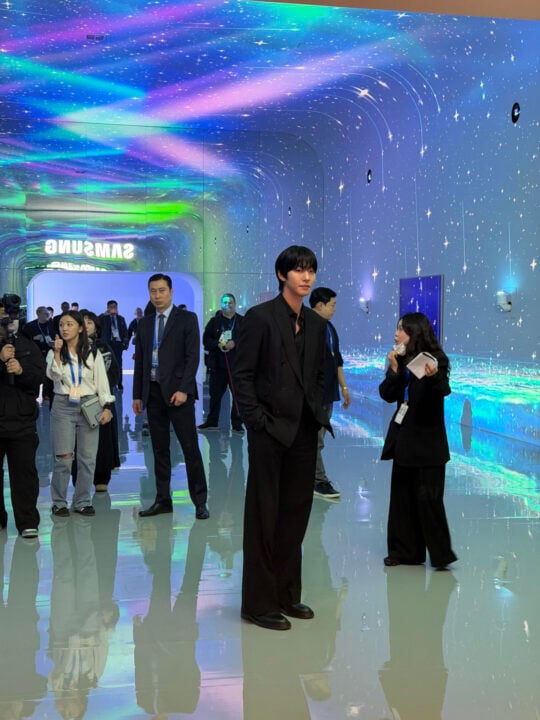
Outside TVs, K-pop group Rise was in the audience of the press conference. They did not perform. Ahn Hyo-seop (the voice of Jinu from KPop Demon Hunters) was also there, and I only barely restrained myself from asking for a picture with him.
Continuing the musical theme, Samsung announced a new Wi-Fi speaker series, Music Studio, which looks like a concave boob, or the negative space around a boob. The designer was inspired by a circle with a dot in the middle of it.
While I wasn’t impressed by how tinny the Music Studio 5 sounded (it would benefit greatly from a subwoofer), I was pleasantly surprised by how robust the Music Studio 7 sounded. For a small speaker, it had great depth and power.
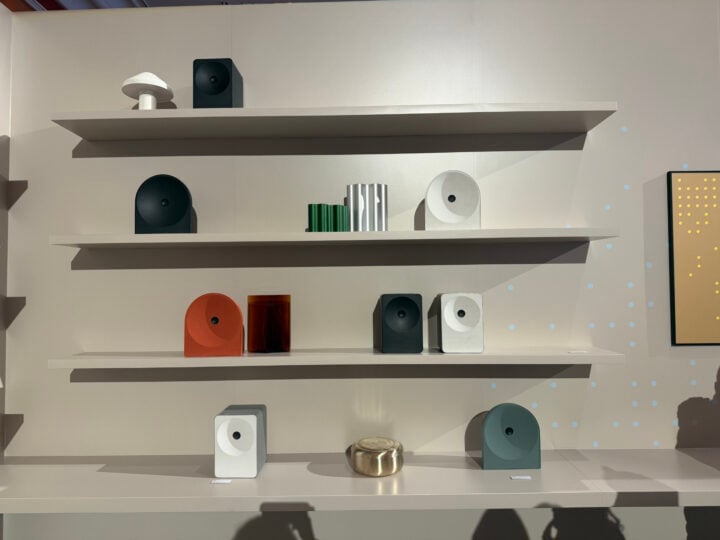
Again, I was in a loud room, so I couldn’t do in-depth testing. However, my early impressions were promising. Interestingly, this Wi-Fi speaker system isn’t trying to replace Sonos, and instead is working with Spotify Play Everywhere.
Food recognition and smart appliances
In home appliances, the washer dryer combo is now even smarter, though I was unable to test that with a load of laundry, and the Family Hub fridge can now recognise more food types, keep track of them better and remind you to use them before they expire.
From a food waste perspective, I really love that vision. What made me a little uncomfortable was how Liz Anderson, VP of Appliance Integrated Marketing, spoke about the new Food Notes feature, which gives you a weekly food report telling you what you ate most of so you can make “smarter choices”.
If Food Notes worked by saying “hey, you ate all the peaches in the first two days of the week, you might want to get more of them, and buy less broccoli, because this is the third week in a row you’ve had to throw it out after it went bad and I think it’s time you just met yourself where you are” that would be great. Those are helpful, actionable insights without judgement.
If it’s saying “hey fatso, you ate a whole loaf of bread, try switching to something lower carb before they have to remove you with a crane, now drop and give me 20 pushups”, then that would be bad.
I am noticing how we’re descending back into 90s-style diet culture, and I don’t love how many devices are trying to encourage people to count calories and “earn” their food. I’m really hoping this is a fridge that’s encouraging healthy attitudes towards food, rather than the attitudes of the stereotypical boomer parent. Because the feature wasn’t on show in detail, I wasn’t able to determine which camp it fell into.
The AI Vision (food logger) for refrigerators now uses Google Gemini to recognise more food types, and the fridge will get seven years of updates to core functions. The new fridges can recognise the differences between your voice and your partner’s voice, and customise the screen to suit the current user. This whole paragraph is a wild thing to write about a fridge, and it’s fun to see how far technology has come.
In other appliance news, the new AirDresser will steam your clothes in a new way to make them look ironed. The AirDresser is one of my favourite gadgets of all time, so I’m excited about this one. I hope they bring it back to Australia, because more people need to know the joy that is steam wardrobe ownership.
We don’t know when these products will hit stores in Australia, or how much they’ll eventually cost, yet. We’ll keep you posted.
Alice Clarke attended CES 2026 as a guest of Lego and Intel.
The post Huge TVs, smart fridges, K-pop: Samsung’s CES event had it all appeared first on GadgetGuy.
0 (mga) komento:
Mag-post ng isang Komento