


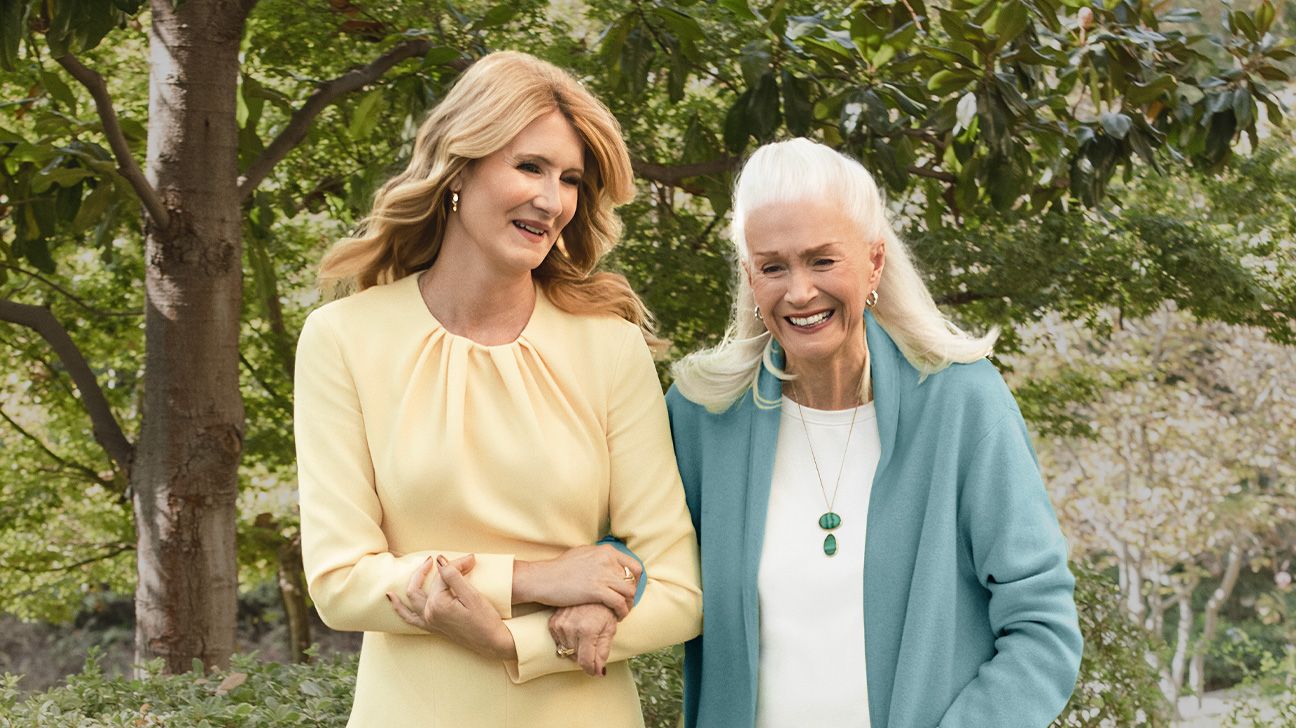
- Academy Award-winning actor Laura Dern is sharing her late mother’s journey with a rare lung disease.
- Dern is carrying out her mom Diane Ladd’s mission of spreading awareness about pulmonary fibrosis.
- The “Big Little Lies” and “Jurassic Park” star reveals open and honest experiences with her beloved mother.
In November 2025, legendary actor Diane Ladd passed away at 89-years-old. Since 2018, she lived with idiopathic pulmonary fibrosis (IPF), one of the most common types of interstitial lung disease (ILD).
For the last 7 years of her life, Ladd and her daughter, academy award-winning actor Laura Dern, advocated for lung health.
Dern described the news of her mother’s diagnosis as heartbreaking; Ladd was initially told she only had a few months to live. But that timeline was extended when she found a pulmonologist who suggested medication, oxygen therapy, and pulmonary rehab.
“[The] two of us knew from pulmonary rehab she could support her lungs with breathing, with movement, with walking, and so, with that clarity, we started to tag team as partners on getting her walking a little bit further every day,” Dern told Healthline.
“[Because] we didn’t know how long she had, we decided to have the conversations we’d never had and I would archive them in my phone for her grandchildren to have about her childhood, her favorite memories, her first movies she worked on, how she met my father.”
This inspired the mother-daughter duo to co-write their memoir “Honey, Baby, Mine,” which chronicles Ladd’s journey with IPF.
“[She] was like, ‘Imagine if other people knew what to look out for, knew to get imaging so they could get proper diagnosis, and knew that there was a community of people also struggling when you get a diagnosis like that,’” said Dern.
Recognizing early signs of pulmonary fibrosis
To honor her mother, Dern carries on their work through the awareness campaign Beyond the Scars, launched by Boehringer Ingelheim, which empowers others to recognize the signs of pulmonary fibrosis (PF).
This initiative encourages early screening and working with specialists to develop a management plan that can help maintain lung function.
“Pulmonary fibrosis is a disease characterized by progressive lung scarring, which often results in permanent damage and reduces quality of life,” John Odackal, MD, pulmonary and critical care specialist at The Ohio State University Wexner Medical Center, told Healthline.
Odackal said that early detection of pulmonary fibrosis permits timely treatment, which can prevent or delay the life-changing symptoms associated with pulmonary fibrosis such as cough and progressive shortness of breath.
Jeffrey Horowitz, MD, director of The Ohio State University Comprehensive Interstitial Lung Disease Program, told Healthline that medications can reduce the progression of disease, but cannot reverse or cure the disease.
“This is why ongoing research in IPF and other forms of progressive pulmonary fibrosis is essential,” Horowitz said.
For those who meet certain criteria, Horowitz said that supplemental oxygen can help them be more active, while pulmonary rehabilitation programs can help improve endurance.
“It is also important to look for and treat common co-morbidities in patients with IPF,” he continued. “These include conditions such as pulmonary hypertension, obstructive sleep apnea, and heart disease. Treatment of these co-morbidities can significantly improve patients’ function.”
Healthline recently spoke with Dern to learn more about her late mother’s disease and how she’d like her to be remembered. This interview has been edited and condensed for clarity and length.
How did your mother receive an IPF diagnosis?
Dern: First, she’d been misdiagnosed, probably for a couple of years — shortness of breath, coughing in her case, acid reflux.
They were saying it was asthma and an esophageal issue. I remember several times, she said, “I have an instinct, something’s wrong, I can feel it in my lungs.” And several times, doctors said, “But are you a smoker?” And she’d say “No.” And they said, “Well, it’s not lung disease.”
Her heartbreak, and one of the reasons why she was personally so excited about joining forces for this program Beyond the Scars, was she wanted people to know that was wasted time.
She could have had a couple more years to get ahead of this and the diagnosis was beyond daunting, was devastating, because it is an irreversible disease and progressive.
We could have found a lot of other support solutions for her long-term health, and I think that’s why she felt so passionate about making sure people were looking out for early warning signs. We were told she had three to six months to live and doctors said to me in front of her, “Just be gentle with her. There’s nothing you can do.”
My mom was like, “What about therapy? What can I do? They were like, “Really nothing. We don’t know much about the disease. There’s no known cause.” And then our first step was finding a great pulmonologist to help guide us with the opposite point of view about how much there was to help support her lungs.
“If I can help one person, Laura, my life mattered.”
Diane Ladd
What would you like other caregivers to know?
Dern: My mom continues to teach me every day, including by demanding that I spread the word as part of her legacy. She always said, “If I can help one person, Laura, my life mattered.”
And she always felt that as an actor, [that she wanted to] connect to others and connect to the space that inspires empathy in storytelling. That was the same with her own life struggle in this diagnosis.
Being inspired by mom’s purpose-driven life as a caregiver, I had to learn how to get out of the way. I think even as a daughter, I was listening to that very first diagnosis with a sense of her having three months and to be delicate with her.
So when she’s like, “I don’t believe them. I’m going to keep going. I want to go make a movie, let’s get more answers. I need a second opinion,” I was trying to slow her down, and she was like, “I’m gonna act till I die. I’m gonna write till I die. I’m gonna teach others till I die. I’m gonna be of service till I die.” And literally, that was her commitment, and I’ve never seen a more vibrant example of that in my life.
Also, she was the one who suggested my own self-care. She could see that I was getting burned out or over-exhausted. I’d slept, let’s say, five nights in a row in a hospital… and so she would demand I go home, get sleep…and I remember not too long ago, I was alone with mom. I wanted to make her breakfast, and she was like, “Call my neighbor. She’ll sit with me. You need to go work out [or] walk your dog. You need 30 minutes where you move your body.”
And I was like, why is my mother trying to mother me? This is about her. And I would almost get resentful while I was trying to caretake. But what she knew was that ultimately, I would be a better caregiver. Ultimately, I could be more patient and that I would remember to ask the questions when we got that four minutes when a doctor would walk in a hospital room.
What would your mom want others to know about this disease?
Dern: She would want to share that because there is no known cause of idiopathic pulmonary fibrosis, and there are 200 some diseases under the banner of interstitial lung disease, people are going through a myriad of different symptoms.
Also, because she was so driven, which was her great gift to all of us in her art and her parenting and grandparenting, she would also want people to know that she avoided bad news at all costs.
She would rather believe the doctor who says, “I think it’s just allergies,” instead of trusting that instinctual voice that said something’s wrong with my lungs because avoiding it meant less ability to go on location and do what she loved or less time on the planet. But she would want people to know that if they get early diagnosis, there is so much support they can get and [they can find] a community who is there for each other like she was.
She had pulmonary rehab virtually through COVID, and there were a lot of people in her group that you could feel how they would give up. I’d pop in for visits virtually, and you could see that they didn’t think they could do a two-pound weight [or were afraid to] breathe too hard.
My mom was just vigilant about [saying], “Come on, you can do it, are you kidding? This is nothing. I’m at year six.”
Is it rewarding to live out your mom’s purpose?
Dern: It’s always rewarding for every citizen to use their voice. This is our birthright, this is our power, this is our empathy; it is how we take care of each other.
That’s how I was raised by my mother, and I’ve been proud to use it, but there is nothing as deeply personal, as profoundly difficult, but as much a gift as honoring her legacy in the way she made me promise I would. And I will do it for the rest of my life in every way I can. So that’s a great privilege.
Laura Dern Turns Grief Into Advocacy After Late Mother's Battle with Rare Lung Disease
Source: Pinoy Lang Sakalam
0 (mga) komento:
Mag-post ng isang Komento