


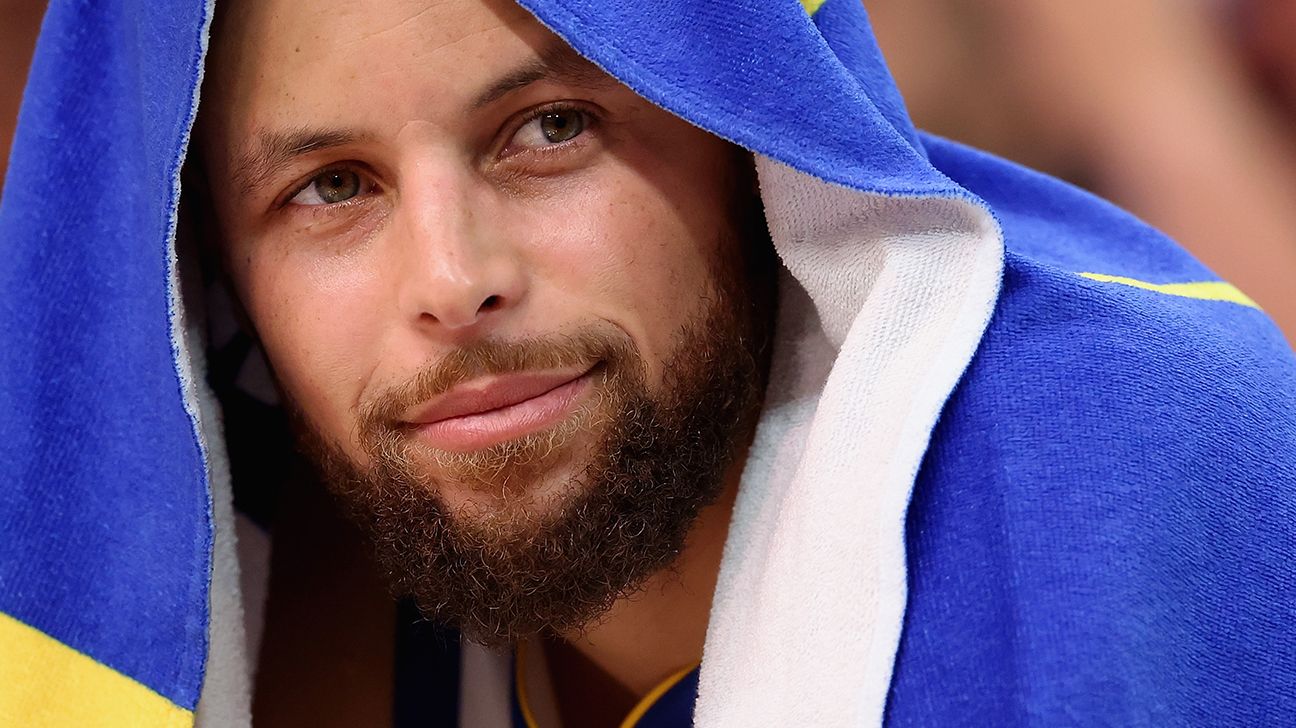
PHOENIX, ARIZONA – APRIL 17: Stephen Curry of the Golden State Warriors during the first half of an NBA play-in tournament game at Mortgage Matchup Center on April 17, 2026 in Phoenix, Arizona. (Photo by Christian Petersen/Getty Images)
- NBA All-Star Stephen Curry is opening up about living with keratoconus, an eye condition that can cause blurry or distorted vision.
- Curry was diagnosed after former Golden State Warriors general manager Bob Myers noticed him squinting during a game and encouraged him to get his eyes checked.
- Keratoconus can worsen over time, but early diagnosis and treatment can help correct vision and may help prevent the condition from progressing.
Twelve-time NBA All-Star and two-time MVP Stephen Curry is known for leading the Golden State Warriors to four NBA championships.
In addition to basketball accolades, being part of the Warriors dynasty made him aware of an eye condition he was living with called keratoconus (KC).
The condition causes the cornea to thin and bulge outward into an irregular cone shape instead of staying round.
This can cause blurry or distorted vision, increased sensitivity to light, glare and nighttime halos, frequent or rapid changes in eyeglass prescription, and eye irritation or redness.
“I didn’t know anything about it before I went to the doctor, nor did I really know that I had truly blurry vision or, like, distorted images and stuff,” Curry told Healthline. “It was kind of just the way I saw things, and for whatever reason, I didn’t ask the questions or go have an eye screen and all that until our general manager for the Warriors, his name’s Bob Myers, [pointed it out].”
In 2018, Myers was watching Curry play on TV and noticed that when the camera zoomed in on Curry sitting on the bench, he was squinting as he watched his teammates and looked at the Jumbotron. Myers took a photo of Curry squinting on the TV and texted it to him after the game.
“He’s like, ‘Hey, you were doing this the whole time they had you on camera. Have you gotten your eyes checked?’” said Curry. “And then that was the first idea of like, ‘Wait, is there something off about the way, you know, my vision was?’ Thankfully, I had access to go to an eye doctor and got a screen. And that was the first time I heard the word keratoconus.”
How treatment for keratoconus changed Curry’s vision
At 29 years old, Curry was diagnosed with KC and learned that it’s a progressive eye disease that can worsen over time.
“[There’s] a certain time window of your life [when it becomes] an irreversible sight-threatening condition,” he said.
Randy McLaughlin, OD, associate professor of clinical ophthalmology at The Ohio State University Wexner Medical Center, said the condition can worsen if not treated and may make obtaining a driver’s license or working difficult.
He said people with the condition are usually fitted with rigid gas permeable contact lenses, which are firm lenses made of breathable plastic and silicone that allow oxygen to pass directly through to the cornea. Some people get larger scleral contact lenses, which are wide enough to vault over the cone-shaped cornea and rest on the white of the eye.
“Patients may be treated with a medical therapy called corneal cross-linking, which hopefully stops the progression of keratoconus,” McLaughlin told Healthline.
Once Curry figured out corrective lenses, he said, “I could actually see clearly and stop squinting, stop having those weird little headaches that would come, that I didn’t associate with my vision.”
While it took some trial and error to get his lens prescription correct and feel stable enough to play basketball, once he did, he couldn’t believe the difference in his vision.
“[I] was the most annoying person probably that first two weeks, ‘cause any time I walked in the room, either I’d be awkwardly staring at you, ‘cause I can see you clearly, or making a comment [like], ‘I can see all the dust in the air, like, this is incredible,” Curry said.
On the court, he could see his teammates better.
“[It] was just a whole new world, for sure,” he said. “[I] realized for the longest [time] I was just adapting and adjusting to what I saw.”
Curry continues to have eye screenings twice a year to monitor the condition.
Keratoconus symptoms and why early diagnosis matters
KC is most often diagnosed during puberty and the teenage years and progresses during a person’s twenties. Delayed diagnosis may increase the risk of irreversible vision loss.
McLaughlin said KC is easily diagnosed at an eye doctor’s appointment with an instrument called a keratometer. However, additional testing may be required.
Your eye doctor may test for it if they notice sudden or severe changes in your astigmatism or nearsightedness, if your vision hasn’t improved with standard eyeglasses, or if you have an irregular corneal reflection.
Although the condition is not inherited in most cases, it can occur in some families.
“Family history of every patient is important, including any family history of keratoconus,” said McLaughlin.
To spread awareness about keratoconus and the importance of annual eye exams, Curry partnered with Glaukos for its Could it be KC? campaign.
Because KC disproportionately affects Black and Hispanic populations, he especially hopes to reach these communities.
“[The] reach that I have and the authentic story of what this has kind of been like for me is the reason I’m doing it,” Curry said. “The work that me and my wife are doing in our foundation in Oakland — the kids that we’re serving — this is a message that they need to hear.”
To connect with more young people, he took part in an educational community event at Madison Park Primary in Oakland on Wednesday, September 23, 2026. At the event, he introduced a new picture book, “Eye on the Ball,” inspired by Curry’s own experience living with KC, and designed to make conversations about eye health and KC more approachable.
“You want to give a visual, especially for kids, to kind of destigmatize what it means to go to a doctor, ask uncomfortable questions, be in that environment where it can be overwhelming at times for sure,” said Curry.
He empathizes with children and people of all ages who are living with undiagnosed KC.
“I can only imagine [because] the way that I saw the court, sometimes struggling to see the screen to watch film, like, little things that you just adapt to and figure out, for younger kids, high school kids, college, [those] in the workforce, you realize…that’s energy exerted,” Curry said. “It’s a hurdle that shouldn’t necessarily be a thing that you have to deal with, but it’s only going to get corrected if you have the awareness to go get it checked.”
He encourages people to see an eye doctor if something doesn’t feel right.
“[There] were plenty of moments for me in that respect, where… things are designed a certain way to be able to see them, and if you can’t, you have to make adjustments to do it, or you have to ask somebody, ‘You know, what does that say up there?’”
Curry hopes that sharing his story encourages more people to schedule eye doctor visits and that more people with KC get the care they need.
“[Hopefully their] outcome is similar to mine, as well, where it’s just a matter of getting checked and getting the right answers for what your situation is,” he said.
NBA Star Stephen Curry Didn’t Know Why His Vision Was Blurry Until Someone Spotted This Sign
Source: Pinoy Lang Sakalam
0 (mga) komento:
Mag-post ng isang Komento