


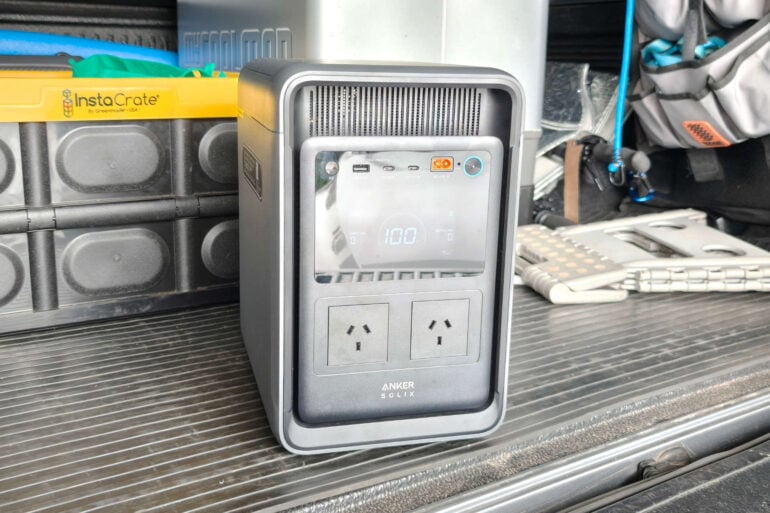
Where once you might have used a petrol generator to provide power remotely, a portable power station like the Anker Solix S2000 can, in most cases, replace that noisy, smelly fuel-powered generator.
The main downside of portable power stations is their battery capacity, and you cannot just add more petrol to keep them running. If the sun is shining, you can plug in solar panels, but you may need many panels to keep up with a high power draw.
The simplest solution is to buy a power station with a bigger capacity or bigger battery. Power stations measure capacity in watt-hours. The bigger the battery, the more power you have, but the power station also gets heavier and bigger. In 2023, I bought a power station to run a fridge and Starlink in my 4WD. It had 2,000Wh capacity, weighed 28.1kg, and measured 39 x 42 x 28cm. This unit is really a two-person job to get in and out of my car.
More power in a smaller unit
Fast-forward three years, and Anker sent me their new model: the Solix S2000, which costs $2,199 via Anker’s online store (discounted to $1,399 at the time of writing). It is also a 2,000Wh battery, but it weighs 16.2kg and measures 21 x 28 x 32 cm. Thus, in three years we have seen a 42% reduction in weight and a 50% reduction in size. I can easily get this in and out of my 4WD by myself.
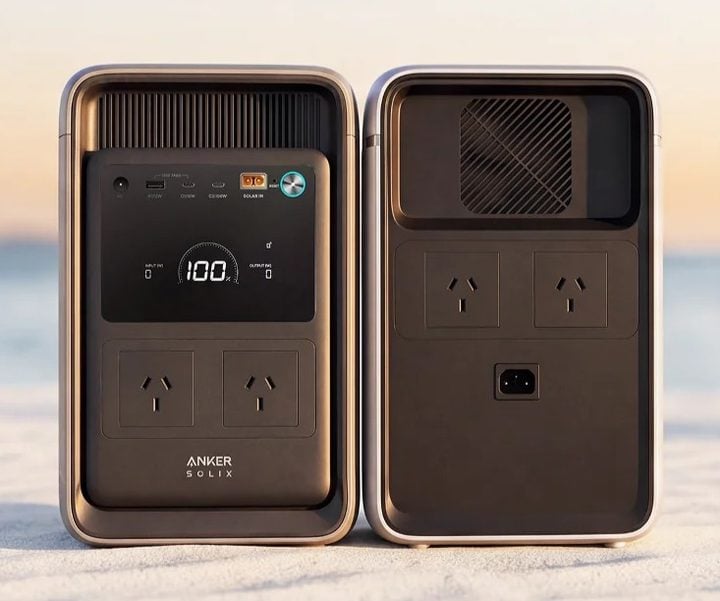
Do we have an even comparison? Both units can provide 240 volt power for appliances. The Solix has a maximum AC output of 1,500 watts, and my old power station has 2,200 watts. This means the Solix is unlikely to power a hair dryer or a coffee machine.
I could use the S2000 to power my fridge and Starlink in the car, but only on 240 volts, as there is no 12-volt output, which would also mean that I could not run the fridge as long on AC (rather than DC) without charging. This is notable because AC power draw from a DC battery wastes power doing the conversion.
However, the S2000 has some new technology to minimise that power loss both when running the inverter (to provide 240V) with no power draw and when running low loads like a camping fridge.
Power station improvements in recent years
Over the past three years, we have seen size and weight decrease, far more efficient power transfer from the battery, and other advancements.
The usable life of lithium batteries has improved from around 3,500 recharge cycles in my old power station to 10,000 cycles. The power station has two USB-C sockets instead of one, plus a USB-A socket. Notably, the maximum USB-C wattage remains at 100W. I would have been happier to see 140W on the latest model.
If you use the S2000 as a UPS to keep critical devices online during a power outage, it switches over in <10 ms, so sensitive electronics don’t lose power. Power input plugs are also standardised rather than proprietary, so if you damage a cable while travelling in Australia, you are more likely to get a replacement.
Like a lot of portable power stations, the Solix S2000 supports various recharging methods. Plugging it into a power point goes from 0-80% in 1.2 hours. It also supports up to 400W of solar charging, where full sunlight charges the battery to 80% in 4.5 hours. While driving, using the car’s cigarette lighter tops up the battery in 18 hours of driving, and an optional alternator charger tops it up to 80% in 4.5 hours. Why 80%? Because that last 20% takes a lot longer to charge (up to 30 minutes more on mains).
While I was testing, a friend rang me; he had a planned home power outage and borrowed the unit to run his fridge and freezer. After about a three-hour outage, the battery was down to 85%. The app could have measured this precisely, but because it was set to my Wi-Fi network, I discovered it doesn’t store data; it uploads in real time. This makes no sense, since you most likely won’t have Wi-Fi during a power outage or when using it remotely.
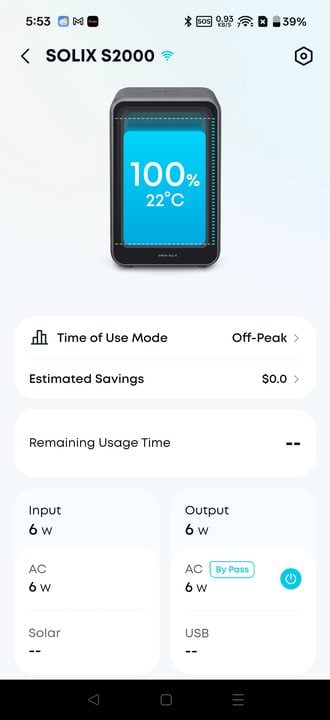
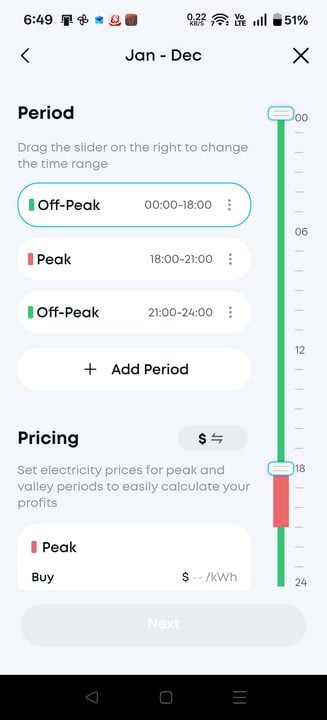
Beyond that, the app is useful not only for monitoring the power station (via Wi-Fi or Bluetooth) but also for remotely switching on the AC and controlling charging. If you have solar panels and no home batteries, you could use this power station to save money by charging it during the day when you are producing solar and, say, running your fridge or TV at night off the battery.
Personally, would I run the Anker Solix S2000 in my car for touring? No. But that’s because it has no 12-volt output, although the weight and size savings are a big incentive. If you are an occasional camper, you probably don’t have 12-volt gear, so this would be a great unit, especially if you can also use it at home. This unit may also be great for a tradie for remote power, but check your power tool’s wattage rating, as it may exceed the 1,500W output. I am planning to run my TV on it.
The post Anker Solix S2000 shows how portable power has changed in 3 years appeared first on GadgetGuy.
0 (mga) komento:
Mag-post ng isang Komento