


Hisense may have had some fun, bringing robot cowboys to spruik its home appliances, but when it came to home entertainment, it was all business.
The big thing Hisense pushed at its CES 2026 booth was its range of RGB Mini LED TVs. A rep boasted that Hisense was the first in the world to introduce the technology last year, then debuting the largest Mini LED TV on the market.
Now, the brand’s new ‘evo’ model has a point of difference: a cyan-coloured backlight. This reportedly allows the TV to show 110 per cent of the BT.2020 colour standard, up from 100 per cent last year. Looking at the colour prism (the chart that shows how much of the visible light spectrum a TV can convey), the spread of colours now looks less like a triangle, and more like a drunk rhombus.
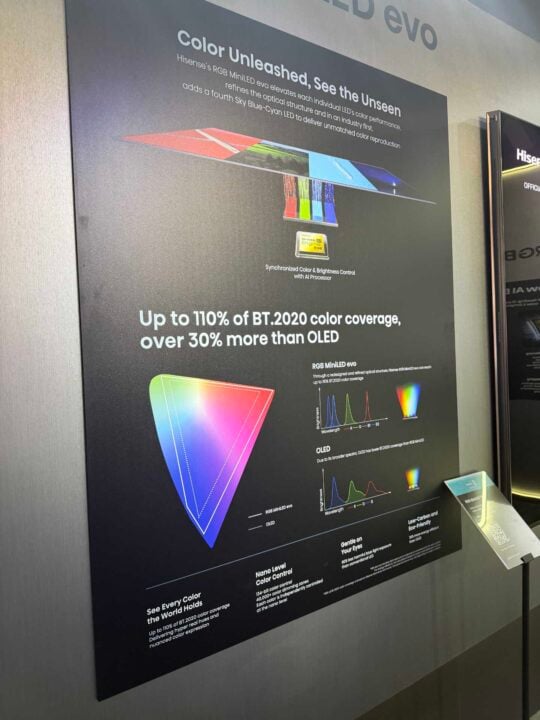
That’s a big deal, because we’ve just had several years of all the big TV brands waging war over who can have the most brightness. The next battleground is going to be colour, and how vibrant and true to life the colours can be.
Hisense’s RGB Mini LED technology up close
Seeing the TV in person, I can say that the colours do look pretty accurate on the demo loop video, which is nice. It’ll be interesting to see how it looks on my test videos when I get my hands on a review TV.
The nice thing is that RGB Mini LED TVs are more energy efficient than quantum dot TVs, because each pixel only has to turn on the colours required, rather than trying to turn on everything and then go through a couple of layers of dots.
Availability and pricing haven’t been announced yet, but the price is estimated to be closer to OLED, while being higher than Hisense’s existing ULED range, now that these TVs are going to be available in all sizes.
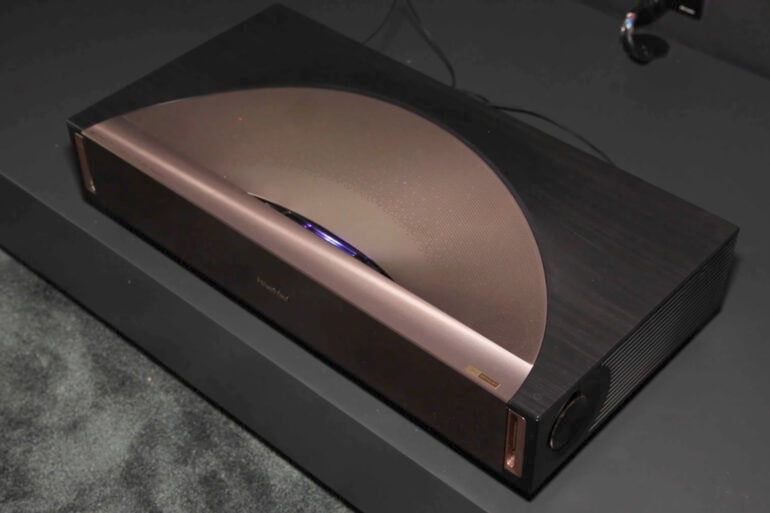
Separately, Hisense showed off its latest Laser TVs, referring to the brand’s laser projector technology. Considered different to its standalone projectors, Hisense’s Laser TVs come with a screen in the box, providing a ready-made projection surface.
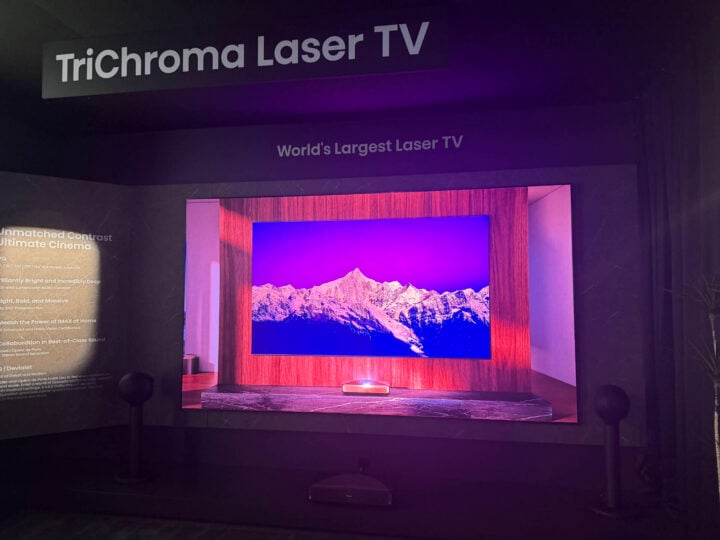
Included in this year’s Laser TV range was the L9Q, which can project an image as big as 200 inches. Overseas, it’ll ship with up to a 150-inch screen. Sadly, only the model with a 120-inch screen will be available in Australia. At least it’s the same console in the box, so you can technically turn it into a 200-inch projector if you want (and have the wall space). I know I certainly want to do that.
Notably, the L9Q is capable of reaching up to 5,000 ANSI lumens of brightness, nearly on par with Hisense’s 6,000-lumen bright XR10 model. Both are considered very bright as far as projectors go.
More AI TV technology
Of course, being CES, there’s going to be an AI section across all the TVs and devices running Hisense’s software. On a related note, the TV operating system is being renamed from ‘VIDAA’ to ‘V homeOS’, which will now be found on more Hisense home appliances with a screen. On top of TVs, this includes appliances like ovens, fridges and washing machines, allowing you to check on the progress of one device from another.
Hisense’s TVs will use AI algorithms for sound and picture upscaling, and the AI game mode can now understand which kind of game you’re playing for better audio and visual upscaling. This AI will also attempt to do the same for sports, docos, and movies.
Hisense’s thinking behind the AI boosting features is that its TVs shouldn’t just be for good, well-made content, but also poorly made content. So, AI Clear Voice boosts the dialogue so you can hear it over the booming music on poorly mixed Netflix shows, and the AI HDR upscaling adds HDR to shows that don’t have HDR, like Friends.
Old-school content that was filmed with steps for brightness can be adjusted to look more evenly lit. That will likely irritate the cinephiles, but might please people who don’t care about the original picture or the intention behind it, and just want it to look as good and modern as possible. There will be settings available for both sides of the fence.
Of course, Hisense also uses the bad kind of AI: generative. The company has partnered with Microsoft Copilot so users can ask the TV how to use its features, like enabling picture-in-picture with an iPhone on the screen. At least the demo didn’t just show a person asking the TV to tell them what the children’s movie they were watching (and apparently unable to comprehend) was about.
Hisense’s refreshed V homeOS also changes the UI to surface “content” you enjoy from all your streaming services. The experience is intended to be like Netflix’s ‘continue watching’ feature, but across all your services. To like Hubbl, but if people actually used it. You can still jump into the individual apps, but you don’t have to.
Plus, there’s a new routines system that supposedly knows what you do in the morning, afternoon, or evening, and gives you a quick overview of the weather, news, and so on to match your needs. It’s surveillance that shows how much data companies have on you, but employed in a kind of useful way.
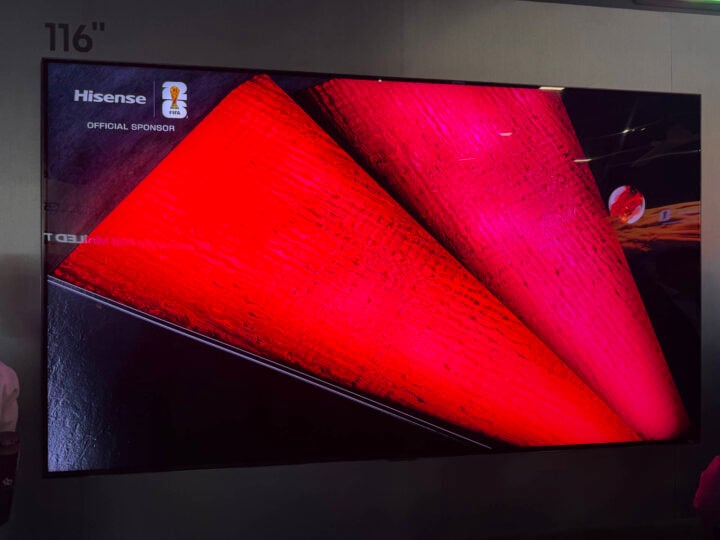
All the features can be opted out of, except ads. You can’t opt out of ads even on the $40K 116-inch RGB Mini LED TV.
Alice Clarke attended CES 2026 as a guest of Lego and Intel.
The post Hisense’s projectors are getting brighter, and TVs more colourful appeared first on GadgetGuy.
0 (mga) komento:
Mag-post ng isang Komento