


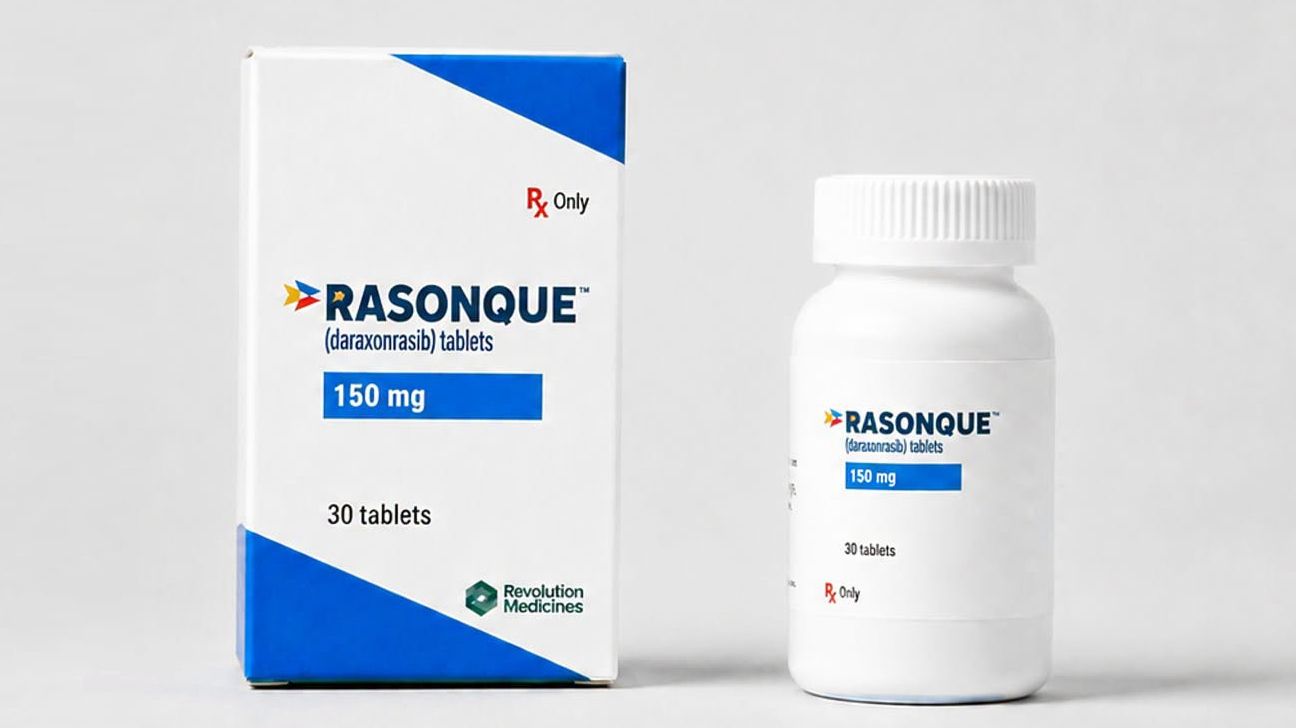
- The FDA approved Rasonque, a new drug to treat the most common type of pancreatic cancer.
- A clinical trial found that those who received Rasonque had more than double the average survival rate: around 13 months compared to just over 6 months with chemotherapy alone.
- Pancreatic cancer was the sixth most common cause of cancer-related death globally in 2024.
A groundbreaking new drug has ushered in a new era of treatment for a deadly form of prostate cancer.
The Food and Drug Administration (FDA) approved a new drug, Rasonque (daraxonrasib), on August 26, to treat pancreatic adenocarcinoma, the most common type of pancreatic cancer.
Pancreatic cancer was ranked the 12th most common cancer in 2024, with more than 530,000 estimated diagnoses globally. It is the sixth most common cause of cancer-related death, contributing to more than 490,000 deaths.
The new drug targets a specific protein known to drive pancreatic cancer tumor growth.
The medication is for people with metastatic pancreatic adenocarcinoma — meaning the cancer has moved outside the pancreas to other parts of the body — who have previously received systemic therapy for their cancer, such as chemotherapy.
The FDA approval is based on the results of a Phase 3 clinical trial for Rasonque, in which study participants receiving Rasonque had an average survival of 13.2 months, compared with 6.7 months with chemotherapy alone.
“This is probably the most exciting study that has been reported in pancreas cancer in the last 30, 40 years, if not forever,” said Anton Bilchik, MD, PhD, surgical oncologist, chief of medicine, and director of the Gastrointestinal and Hepatobiliary Program at Providence Saint John’s Cancer Institute in Santa Monica, CA.
“It’s truly astonishing that such patients with advanced pancreas cancer, who have a very poor outcome, can get a pill after they have failed first-line chemotherapy and have a doubling of survival, compared with those patients that just got standard chemotherapy,” Bilchik told Healthline.
Rasonque targets RAS genes to fight pancreatic cancer spread
Rasonque is a drug that targets a family of genes called RAS.
“RAS is a driver of pancreas cancer,” Bilchik said. “RAS is present in more than 90% of the most common pancreas cancer, which is adenocarcinoma. RAS drives the change in cells from normal to abnormal, to becoming cancer.”
Rosario Ligresti, MD, chief of gastroenterology at Hackensack University Medical Center in New Jersey, said that these mutated proteins typically send continuous, uncontrolled growth signals to cancer cells. They have historically been “undruggable” due to their hard-to-bind surfaces, Ligresti explained.
“Rasonque overcomes this by acting as a ‘molecular glue’ that first attaches to an abundant cellular chaperone protein called cyclophilin A,” he told Healthline.
Ligresti said this newly formed drug-chaperone complex perfectly conforms to the active RAS protein, locking together to create a “tri-complex” that physically blocks RAS from interacting with its downstream signaling partners.
“By effectively neutralizing a broad spectrum of these active RAS mutations rather than just one specific variant, Rasonque cuts off the continuous cancer-driving signals, halting tumor growth and ultimately causing the cancer cells to die,” he said.
Once-daily targeted therapy slows disease progression
Kyaw Lwin Aung, MD, a medical oncologist at Baptist Health Herbert Wertheim Cancer Institute, noted that prior to Rasonque, the first-line treatment for pancreatic cancer was chemotherapy.
“Now with Rasonque, we have a new targeted therapy that is much more effective than chemotherapy,” Aung told Healthline.
Rasonque differs from the traditional intravenous chemotherapies used for metastatic pancreatic cancer, which indiscriminately attack both healthy and cancerous cells.
“Rasonque is a convenient, once-daily oral pill that provides targeted therapy by directly shutting down the specific RAS mutations driving the disease,” Ligresti said. “Rasonque is uniquely ‘multi-selective,’ successfully neutralizing the mutations responsible for over 90% of pancreatic tumors.”
“By replacing highly toxic, ‘scattergun’ chemotherapy with a highly precise mechanism, Rasonque nearly doubles overall survival to 13.2 months while simultaneously sparing patients from grueling side effects and vastly improving their daily quality of life,” Ligresti continued.
Possible side effects of Rasonque
Aung was a study author of the Phase 1-2 study for Rasonque, which evaluated the drug’s safety and side effects.
Some of the most common side effects of Rasonque may include:
- skin rash
- sore mouth (mucositis)
- nausea
- diarrhea
- fatigue
“The survival improvement achieved with Rasonque is unprecedented in the treatment of metastatic pancreatic cancer,” Aung said.
“Every metastatic pancreatic cancer patient should be considered for this treatment unless there are serious medical and/or other factors that prohibit prescribing. Patients should have prophylactic treatment for rash. They should be monitored closely for effective management of side effects so that patients can be maintained on the effective dose of Rasonque,” Aung continued.
How does Rasonque compare to chemotherapy?
Experts say there are questions about Rasonque that may need to be answered.
“The obvious question [is] if someone is diagnosed with advanced pancreas cancer and they’re given this drug up front, will it have an even better effect and less toxicity than standard chemotherapy?” Bilchik said.
“The next question is what about patients that are potentially resectable,” he continued. “And that’s by far the minority of patients with pancreas cancer, because by the time they present with symptoms, [they] already have advanced; their cancers have already spread. What if this drug is given up front, even before surgery — will it prolong survival even further?”
While Rasonque offers a groundbreaking new therapy for pancreatic cancer, Ligresti said the medical community will be closely watching post-market data to understand its real-world durability.
How Rasonque stands up against inevitable drug resistance, and how best to sequence or combine it with existing therapies, remains to be seen.
“We also await the real-world economic impact of the new drug, which has been priced at nearly $500,000 for a full [year] of therapy,” Ligresti said.
FDA Approves Breakthrough Drug Rasonque for Metastatic Pancreatic Cancer
Source: Pinoy Lang Sakalam
0 (mga) komento:
Mag-post ng isang Komento