


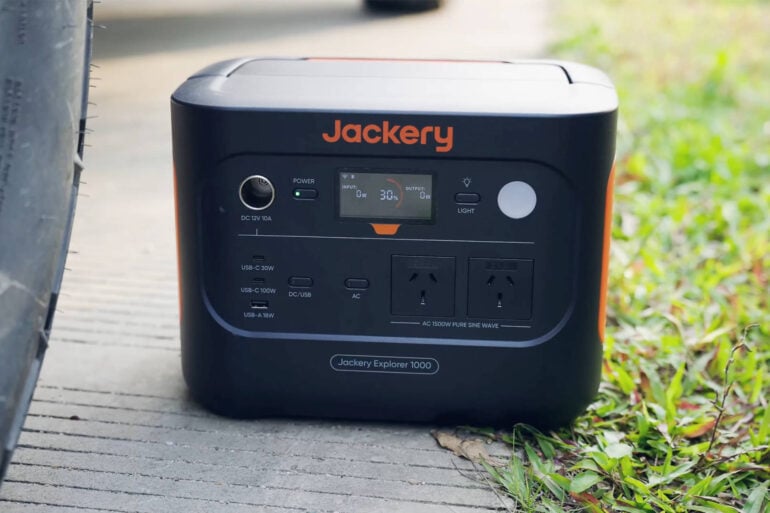
When I first became aware of portable power stations, the Jackery brand from the USA was the brand to have. However, in Australia they were never really sold and, more importantly, supported after sales.
So, while it’s a popular brand overseas, it’s virtually unknown in Australia. Given Jackery is now being sold by Bunnings, this could change quickly. I recently tested the Jackery Explorer 1000 v2, one of the most affordable portable power stations in its weight class.
Features
In other portable power station reviews, I have talked about the sweet spot for size versus weight versus functionality: 1000Wh capacity. That is, the power station’s battery can supply 1000 watt-hours, or in plainer words, run a device requiring 1000 watts for one hour. Alternatively, it can run a 100W device for 10 hours.
In practice, operational losses will shorten this, but you get the idea. On Jackery’s website, a handy calculator estimates run time by wattage; 100W comes out to 7.6 hours, suggesting about a 25% loss.
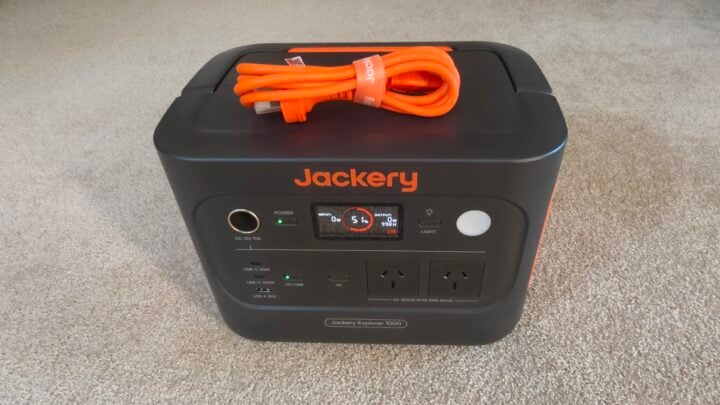
The Jackery Explorer 1000 v2 has a 1070Wh capacity and can deliver 1500W continuously via a 240V, 12V, or USB outlet. At 1500W, this will run a toaster but probably not a hair dryer or a coffee machine. Check the label on the appliance you want to power; if it’s 1500W or below, you are good. A 2,400W hair dryer will run for a few seconds before the power station safety mechanisms kick in and shut the unit down.
You can run a camping fridge, computer, recharge phones, power lights, and even run your home fridge for a few hours during a blackout. The Jackery has two mains outlets, a 12-volt cig socket, two USB-C sockets (30W and 100W) and an 18W USB-A socket. A power switch turns on the power station, with separate buttons for AC and DC power. You can also activate the LED light in low, high, or SOS patterns.
A central display indicates input and output wattage, battery capacity, and predicted charge and discharge times based on the current input or output wattage.
The box includes only one mains cable, which limits your initial charging option to a power point. An emergency charging function, activated in the supporting Jackery app, lets you charge the Explorer 1000 v2 in under an hour. It is not recommended to use this regularly as it will stress the battery and reduce its useful life. Standard charging takes 95 minutes from empty, and quiet mode stops the fan from running, reducing noise during charging and taking even longer.
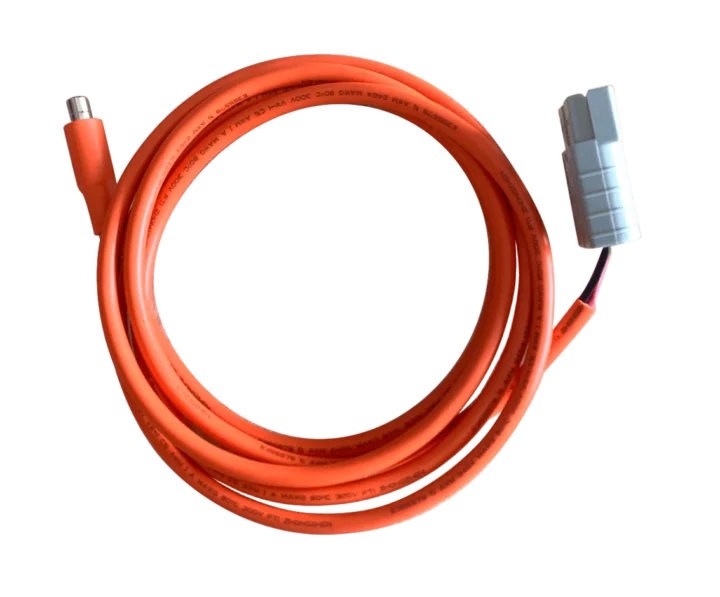
An optional $39 12-volt car charger takes 12 hours to charge your power station, and 200W of solar panels takes around four hours of uninterrupted sunshine. Jackery uses a DC8020 plug to input DC voltage into its power station. This means you have to buy their accessories.
To charge from solar, you either buy their solar panels, which include this DC8020 plug, or buy a DC8020-to-Anderson plug adapter cable for $199. These accessories increase your overall cost compared with standardised plugs and included cables from some other brands.
While we talk about cost, the two big advantages of the Jackery Explorer 1000 v2 are cost and weight. At $799, this model is about $200 cheaper than many competing models. The Jackery is also 700 grams to 2kg lighter than its competition in this class. At the time of writing, Jackery also offered an extra $100 if you subscribed to their newsletter.
Jackery Explorer 1000 v2 specifications and price
| Power output | 1500W continuous (3000W surge) |
| Capacity | 1070Wh |
| Solar input | 400W |
| Dimensions | 33 x 22 x 25 cm, 10.8 kg |
| Price (RRP) | $799 |
| Website | Jackery Australia |
| Warranty | 5 years |
Compared with other brands
| Model | Jackery Explorer 1000 v2 | Bluetti Elite 100 V2 | EcoFlow Delta 2 | Anker SOLIX C1000 |
|---|---|---|---|---|
| Price (RRP) | $799 | $1,299 | $1,199 | $1,499 |
| Capacity | 1070Wh | 1024Wh | 1024Wh | 1056Wh |
| Battery Chemistry | LiFePO4 (LFP) | LiFePO4 (LFP) | LiFePO4 (LFP) | LiFePO4 (LFP) |
| Continuous AC output | 1500W | 1800W | 1800W | 1800W |
| Surge power | 3000W | 2700W | 2700W | 2400W |
| AC wall recharge time | 1 hour (emergency) | 1 hour | 1.3 hours | 0.9 hours (HyperFlash) |
| Max solar input | 400W | 1000W | 500W | 600W |
| Weight | 10.8 kg | 11.5 kg | 12.0 kg | 12.9 kg |
| UPS switchover time | < 20 ms | 10 ms | < 20 ms | < 20 ms |
| Smart features | App control Wi-Fi Bluetooth | App control Wi-Fi Bluetooth | App control Wi-Fi Bluetooth | App control Wi-Fi Bluetooth |
Using the Jackery Explorer 1000 v2
The Jackery does everything the brochure says it does, from running devices through to mains charging, which you would expect. I couldn’t test DC/Solar charging because I didn’t have a Jackery solar panel or adapter cables. At the time of writing, Jackery solar panels were about $100 more expensive for 200W than competitors.
Paired with a 200W $799 solar panel and sunny days, this setup could keep you off-grid continuously while keeping your gadgets running.
The construction is simple and sturdy, and with a large folding carry handle on top, the 11kg power station is manageable with one hand. The unit includes appropriate safety mechanisms that shut it down if any problem occurs, including if you try to draw more power than it can provide. Jackery quote 62 different safety protection mechanisms. The unit comes with a five-year warranty, and you can expect a lifespan of 10 years or 4,000 charge cycles.
For those wanting an economical uninterrupted power supply that keeps sleep apnea machines, computers, and fish tanks running during a blackout, this is a good choice. The switchover time is less than 20 milliseconds, so your device/s stays on.
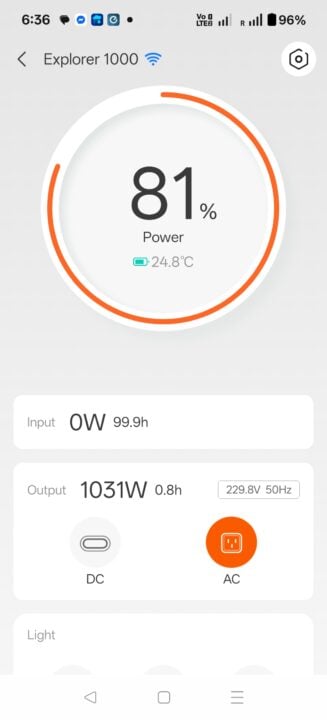
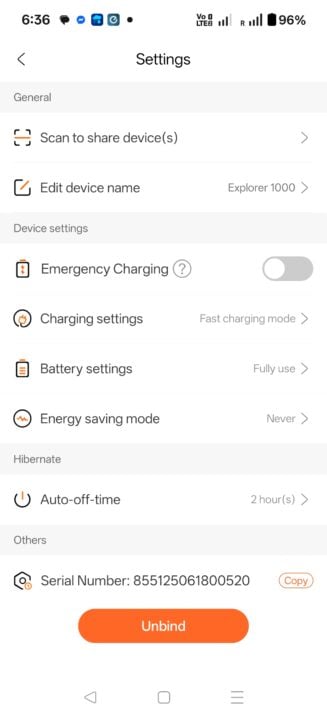
Jackery provides a smartphone app to monitor and adjust your power station. You can connect via Bluetooth or Wi-Fi. A Wi-Fi connection lets you control the power station from anywhere you have internet access. You can remotely switch the DC or AC load and adjust various setup settings. Monitoring lets you see the same information as on the screen, but if your internet connection drops due to a blackout, you cannot connect to see it.
Who is the Jackery Explorer 1000 v2 for?
At $799, this power station is an economical way to take power with you when remote from mains power. Whether running a power tool on a job site, powering a camping fridge, or recharging a drone, this versatile unit is easy to put in your vehicle and move without causing a hernia.
Consider your power needs, as this unit will not run high-wattage appliances, and anything over 1000W will drain the battery in under an hour. If within 30 days of purchase you find it does not meet your needs, Jackery will give you your money back.
The post Jackery Explorer 1000 v2 review: Affordable power for anywhere appeared first on GadgetGuy.
0 (mga) komento:
Mag-post ng isang Komento