


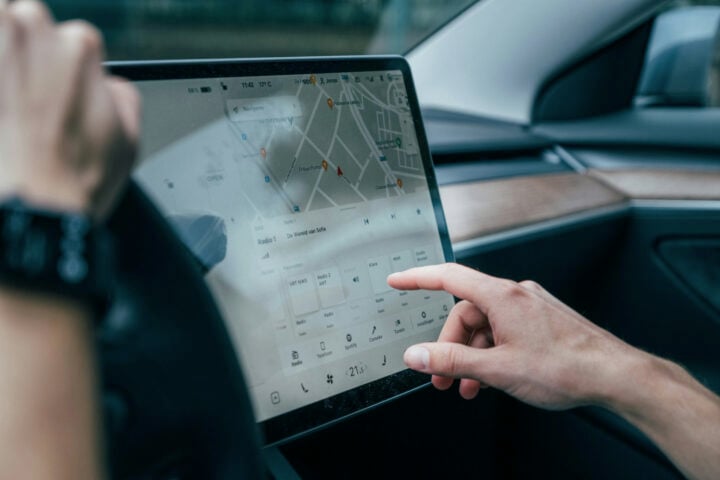
Glancing away from the road to press on-screen inputs can be more dangerous than driving over the limit, with two-thirds of Australians demanding the return of physical buttons in cars, according to the latest research.
A two-second glance away from the road can be more dangerous than a 0.08 blood alcohol level, in scenarios such as driving on rural roads, according to research by global insurance giant Allianz.
With poorly designed menus requiring up to 11 taps to access features, Australian drivers are demanding the return of physical buttons to cars, which can be accessed by feel while still watching the road.
The latest stats on driver distractions
Almost one in three Australian drivers report a “critical moment” behind the wheel while distracted by touchscreen features that force them to take their eyes off the road.
Driver distraction is underreported in official statistics, with two-thirds of Australians identifying distraction as a factor in a collision, according to Allianz, which analysed 34,000 crashes and surveyed drivers from around the world.
As new cars become more reliant on touchscreens, 75 per cent of Australian drivers believe in-car distraction has increased in recent years. In response, 67 per cent would prefer that key features were operated by physical controls rather than on-screen buttons.
“Distraction appears far more often in the crash record than official statistics suggest,” said Allianz’s Dr Klaus-Peter Röhler. “The same everyday task is markedly more dangerous in one car than in another… Manufacturers should make safety-critical functions operable for drivers without taking their eyes off the road.”
“A glance of only a couple of seconds can, at the wrong moment, be as dangerous as driving over the drink-drive limit.”
At 50 kilometres an hour, a two-second glance at a touchscreen means more than 28 metres travelled without watching the road. This extends to 56 metres when travelling at 100 kilometres an hour.
The new research comes amid a growing international backlash against car manufacturers moving physical controls and readouts to touchscreens, such as the Tesla Model Y and Model 3, which lack physical buttons on the dash as well as an instrument cluster behind the wheel.
This leaves Tesla drivers completely reliant on the 15-inch in-dash touchscreen for even the most basic of tasks like checking their current speed. Some models also ditch the physical indicator stalk in favour of buttons on the steering wheel, while relegating gear shifter controls to the touchscreen.
Local regulators call for the return of physical buttons
New 2026 Australian safety standards mark down the safety rating on new cars that rely heavily on complex touchscreen controls rather than buttons and stalks, according to the Australasian New Car Assessment Program (ANCAP), Australia’s peak safety body for new cars.
Key functions such as operating headlights, windscreen wipers, demisters, side mirrors and hazard lights rely too heavily on touchscreen interaction rather than readily accessible physical controls, says ANCAP chief executive Carla Hoorweg.
“Our 2026 safety rating requirements are comprehensive and ambitious, encouraging manufacturers to deliver a broader range of safety features and higher levels of protection,” Hoorweg said.
“We want to see carmakers bring back buttons for the functions drivers use every day. Adjusting your windscreen wipers, switching on your headlights or clearing a fogged-up windscreen should be simple, intuitive and achievable without taking your attention off the road.”
Global push to reduce reliance on in-car touchscreens
Europe’s car safety organisation, Euro NCAP, is also encouraging manufacturers to use separate, physical controls for basic functions to limit the time drivers spend looking away from the road.
Under the new European rating scheme, which came into force in January, manufacturers cannot achieve the highest safety ratings if they don’t provide physical switches for certain functions.
Meanwhile, China will require physical buttons for critical controls in new cars sold in the country from mid-2027. While the ruling doesn’t apply to the export market, it is expected to shape vehicle design out of China, which produces around a third of all cars globally.
Mercedes-Benz, Volkswagen, Hyundai/Kia, Subaru and Audi are among major carmakers that have committed to reintroducing physical buttons. Electric carmakers like Tesla are yet to follow suit, although the EV giant bowed to public pressure and reintroduced indicator and gear shift stalks in 2025 models.
The post Touchscreens riskier than drink-driving as Aussies demand physical buttons appeared first on GadgetGuy.
0 (mga) komento:
Mag-post ng isang Komento