


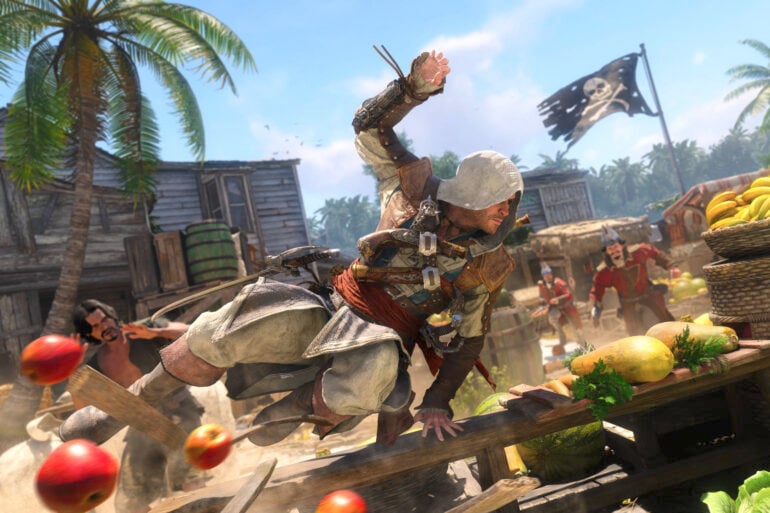
The first thing I did after getting home from playing three hours of Assassin’s Creed Black Flag Resynced was boot up the original. I can barely remember playing Black Flag, long considered the pinnacle of the Assassin’s Creed series, in 2013. Remarkably, Ubisoft Singapore’s remake looks right at home as a 2026 game, while the soul of the game remains largely intact.
If anything, Black Flag’s pirate-themed adventure feels as relevant, if not more, than it did over a decade ago. Edward Kenway’s quest to subvert the class system of the 1700s, where he’d only earn a pittance for his hard labour in comparison to his superiors’ riches, appeals as a fantasy today, where gross wealth inequality continues to divide society.
Doing so sees the roguishly charming Kenway turn to piracy. Of the nautical kind, not the illegally downloading movies variety. He craves a better world for himself and his fellow man, and he believes it to be possible. It’s hard not to cheer for the fellow with such ideals.
At the time, the original Black Flag was considered a stunner. By today’s standards, its age is apparent, but it is by no means an ugly game. Taking advantage of the latest technology, Black Flag Resynced is drowning in beauty. Its characters show more emotional range, there’s more detail in every pixel, and the picturesque aquamarine waters of the Caribbean look postcard-ready.
What I played across an extensive preview spanned three distinct sections: the opening sequence, an hour of sailing the high seas, and a handful of missions set roughly halfway through the game. After three hours, it was apparent that this is a familiar remake, but one that is spectacularly confident in its vision.
Back to the Assassin’s Creed of yore
In recent years, Assassin’s Creed games have grown increasingly expansive. Large open-world locations and RPG systems became central to the series, rather than a singular focus on stealth and one-hit takedowns.
As a result, later entries rewarded time spent in-game over a test of skill. I distinctly remember my final hours in Assassin’s Creed Odyssey, a game I otherwise largely enjoyed (Kassandra could kick me off a cliff and I would thank her), as a grind-filled crawl.
As I neared the story’s conclusion, I encountered a slightly higher-levelled enemy. They weren’t a boss or anyone of note, just a run-of-the-mill foot soldier. And yet, with each hack and slash, their health bar barely diminished, while any return serve stole a chunk of my vitality.
It felt frustrating and wrong on multiple fronts. After dozens of hours spent with a Greek goddess of a character, growing in strength and accumulating more advanced weaponry, why was she barely able to scratch a relative grunt? Arbitrarily gating progress behind an ill-fitting RPG system is one of my greatest annoyances in modern games. Worst of all, the unnecessarily elongated fight was painfully boring.
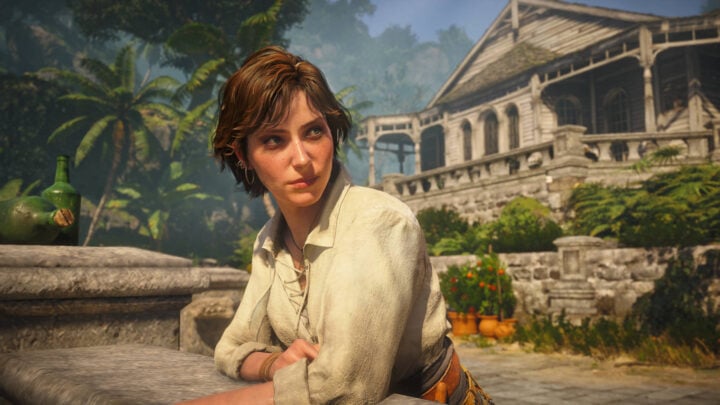
Ubisoft course-corrected to an extent with Assassin’s Creed Shadows. Levelling systems remained, but the dual protagonists in Naoe and Yasuke possessed a greater capacity to take down enemies swiftly, fulfilling the power fantasy and social contract established by the best Assassin’s Creed games.
It’s this era that Assassin’s Creed Black Flag Resynced seeks to return to. Developers from Ubisoft Singapore have gone to great lengths to distance the gameplay from the RPG stylings of recent games. Skill, not DPS (damage-per-second), is Resynced’s mantra. It attempts to smooth over the rough, splintered edges of the 13-year-old original, while attempting to modernise what hasn’t aged as well.
Swashbuckling, sword-swinging action
Going back to the original Black Flag’s combat was a shock to the system. By current-day standards, it’s imprecise and unwieldy, difficult to track enemies during a skirmish.
Resynced leans on the combat system of recent Assassin’s Creed games, mapping attacks to a controller’s shoulder buttons, while making encounters easier to parse with a robust targeting system. Going toe-to-toe with an enemy relies heavily on timing, trading blows until one combatant pierces the other’s defences.
At times, combat swings heavily towards waiting for an enemy to make a mistake. As a scrappy pirate, wouldn’t fighting dirty and creating your own openings be more thematically appropriate? Instead, some land-based fights reached a stalemate, where I awkwardly waited for a foe to make an errant thrust I could parry.
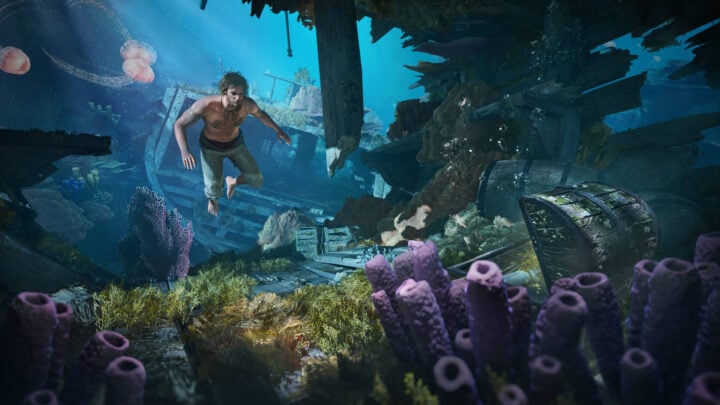
Successfully parrying an attack does create further openings, however. In most cases, perfectly timing a parry lets you brutally take down an enemy in one hit, skewering them like a kebab. One kill leads to another, with Kenway able to swiftly chain multiple takedowns in quick succession, making you feel powerful.
Absent an RPG system may be, but there’s still merit in buying and upgrading new equipment. Better swords let you chain together more takedowns after parrying, so you can carve through more enemies in less time. It’s a much better system than an arbitrary stat upgrade — don’t expect to see a marginally better blade that includes a 2.38 per cent chance of giving your opponent explosive diarrhoea.
Rather than going overboard with upgrades of diminishing returns, Black Flag Resynced gives you logically better equipment to strive for. Buying a new sword doesn’t make Kenway magically more powerful. Instead, it just lets him fight more efficiently and is better able to take advantage of his latent skills.
I’m on a boat
Like the original, much of your time in Black Flag Resynced is spent on open water, commandeering a ship loaded with cannons, manned by a crew with a penchant for shanties.
There’s a compelling rhythm to Black Flag’s naval warfare. Each combatant fires a barrage of projectiles, with a brief respite while each ship’s crew prepares for the next volley. Positioning is arguably the most important factor; it’s a tight balance between sailing close enough to reach an opponent, while leaving enough distance so you’re not a sitting duck after firing your cannons.
In a way, the ship battles are like a choreographed dance. Timing is essential, as is thinking several steps ahead so you’re not caught behind everyone else. Unlike dancing, making too many mistakes will see you blown up and killed (unless there’s an extreme form of dancing I’m unaware of).
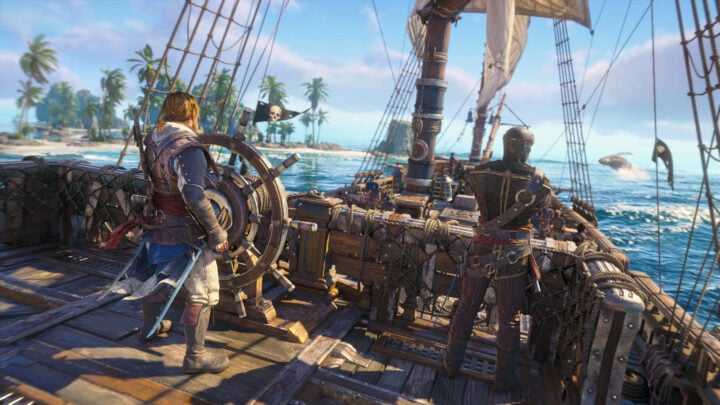
While at the mercy of the seas, the punchy sound design is as important as what you can see. It’s a distinctly Newtonian soundscape in that every action is met with a corresponding reaction. Cannon fire punctuates otherwise calm seas, as projectiles whoosh perilously past your vessel, leaving you to pray that the next salvo won’t land. Ships explode into splinters of wood as if fracturing your very sternum, joined by the panicked shrieks of crew members.
If it weren’t for the fact that you’re solely responsible for the life and death of Kenway and his followers, it’d be a spectacular audio experience to sit back and unpack in granular detail.
Being on top of all this takes a while to grasp. Ships of such grand scale don’t turn quickly, ratcheting up the tension as gunpowder explodes from all directions. I bit off more than I could chew multiple times, but immediately jumped back in, eager for more.
It’s an assassin’s life for me
During one of the missions I played, Kenway remarked to a fellow pirate that it felt like he was stuck running errands rather than living the life he had envisioned. His comment came toward the end of a three-hour session, so perhaps it was fatigue setting in, but it felt apt considering a sense of familiarity had begun to set in.
For nearly two decades, Assassin’s Creed has revolved around a similar gameplay loop. Stalk a target through conveniently placed shrubbery, stab some dudes, and check off countless map markers — there have been some subtle variations along the way, but the nucleus remains the same.
Assassin’s Creed Black Flag was one of the best examples of this structure over 10 years ago, and Resynced reinforces how much Ubisoft got it right the first time (and how little open-world games have tangibly changed since then). In a bizarre Ship of Theseus way, Resynced looks new, but still authentically feels like a game from the mid-2010s, sans the clunky controls.
That familiarity could yet be its greatest strength as Ubisoft bets big on nostalgia. We’ll soon see just how strong the pull of the sea is when Assassin’s Creed Black Flag Resynced launches on 9 July for PlayStation 5, Xbox Series X/S, and PC.
Chris Button attended a preview event in Singapore as a guest of Ubisoft.
The post Assassin’s Creed Black Flag Resynced preview: Ship of Thesseus appeared first on GadgetGuy.
0 (mga) komento:
Mag-post ng isang Komento